























From a small Balkan hometown to the front lines of human spaceflight, Martina Dimoska is shaping the future of the Moon to Mars exploration architecture.
The newly released official portrait captured at the Flight Operations Directorate (FOD) in Houston marks more than a professional milestone.
It reflects a story of resilience, global perspective, and the belief that someone from anywhere in the world can contribute to humanity’s next giant leap.
Today, Dimoska brings international expertise into the heart of the United States human spaceflight ecosystem.

As a Program Human Systems Discipline Integrator supporting the Human Health and Performance Directorate (HH&P) and the Extravehicular Activity and Human Surface Mobility Program (EHP) through Leidos, the work focuses on ensuring astronaut health, safety, performance, and human system requirements across the complex systems that will return humans to the Moon and send crews to Mars.
This includes contributions to Exploration Extravehicular Activity Services (xEVAS) or space suits, the Lunar Terrain Vehicle (LTV), the Pressurized rover (PR), the lunar surface infrastructure, early Moon Base inception, and technical governance aligned with the Artemis and Moon to Mars exploration architecture.
Before stepping into the U.S. exploration arena, Dimoska built one of the most internationally diverse educational foundations in the field.
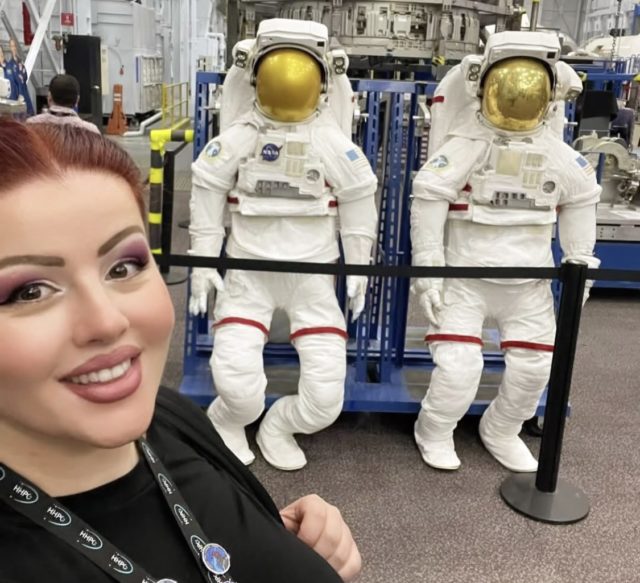
The journey began at Ss. Cyril and Methodius University in Skopje, where Dimoska completed a B.Sc. in Materials Engineering and Nanotechnology.
This was followed by an aerospace engineering exchange program at Kent State University in Ohio, funded by the U.S.
Department of State. Her academic path continued with a graduate degree in the Commercial Space Studies Program at the Florida Institute of Technology in Melbourne, Florida, earned through a rare scholarship from the Aldrin Family Foundation, established by Buzz Aldrin and led by Andrew Aldrin.
Her education journey ultimately culminated in a Master of Space Studies from the International Space University (ISU) in Strasbourg, the first and only such degree held by someone from the home country.
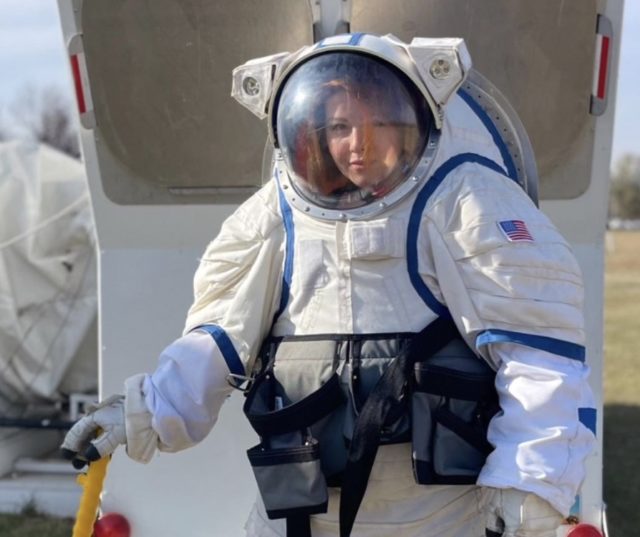
Beyond academic preparation, Dimoska gained global recognition through extensive work as the first female Balkan analog astronaut.
Dimoska commanded the SELENE and TERRA NOVA missions at the LunAres Research Station in Poland, where TERRA NOVA was executed with the AstroMentalHealth project, comparing analog mission data with data collected on the International Space Station (ISS) during the Axiom‑4 flight.
Dimoska also participated in the University of North Dakota’s 14th mission at the NASA‑funded Inflatable Lunar/Mars Analog Habitat (ILMAH), where the crew conducted research connected to ISS experiments such as AstroSkin and ExoLab.
In June 2023, Dimoska joined the APICES analog astronaut mission in Spain, organized by ICEE Space in collaboration with Astroland Interplanetary Agency.
The mission focused on simulating lunar and Martian environments in support of future exploration and research aligned with ESA’s Terrae Novae 2030+ strategy.
Dimoska served as Crew Engineer and Outreach Lead in an international crew led by Aleš Svoboda, studying crew dynamics, robotics, augmented reality systems, and emerging technologies for future lunar and Martian living environments.
In addition to her professional work, Martina is also recognized as a popular science communicator, active under her alias @astrosmarta as well as under her own name across various social media platforms, where she consistently shares accessible and inspiring content related to space and human spaceflight.
Together, these experiences form a bridge between continents, disciplines, and exploration cultures.
They represent how global knowledge strengthens the U.S. effort to design, test, and validate systems that will help astronauts thrive on other worlds.
Dimoska’s path shows that human spaceflight is not only built by cutting edge technology, but also by the people from around the world who choose to dedicate their lives to exploration.
Her story illustrates the expanding international footprint in the American space industry and reflects how diverse perspectives continue to shape the Artemis generation.
It is a reminder that exploration is a global endeavor and that inspiration can begin in any hometown, no matter how distant it initially feels from the stars.